
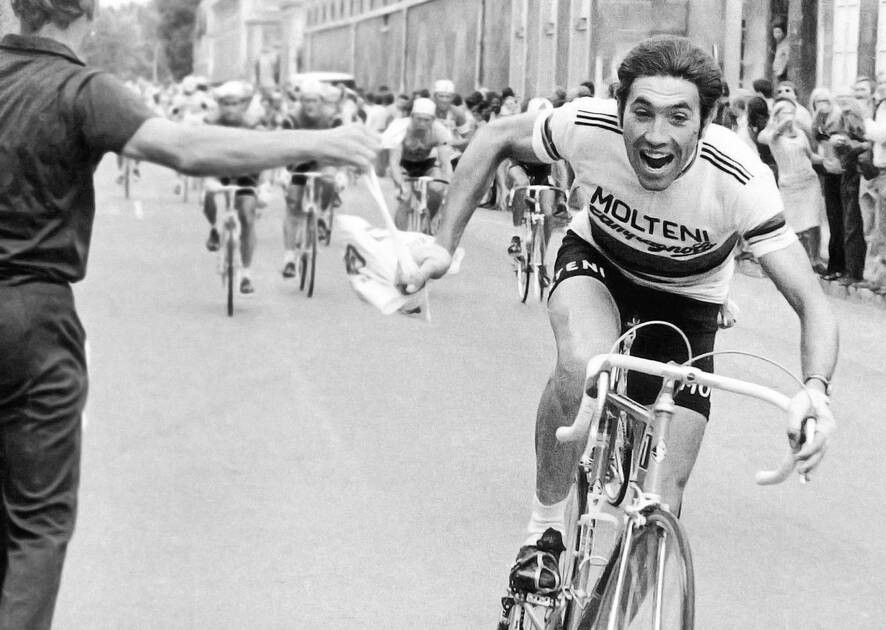
Eddy Merckx and the 1971 World Champion Jersey – The Rainbow That Ruled the Road
When it comes to cycling legends, few names shine brighter than Eddy Merckx. Known as “The Cannibal” for his relentless hunger to win, Merckx dominated the sport during the late 1960s and 1970s. Among his many triumphs, one stands out for its iconic symbolism — his victory at the 1971 UCI Road World Championships, where he claimed the rainbow jersey, one of the most prestigious garments in cycling.
But the story doesn’t stop with the win. What makes the 1971 rainbow jersey truly legendary is how Merckx honored it — by continuing to crush the competition and cement his status as the greatest cyclist of all time.
The 1971 World Championships – Mendrisio, Switzerland
The 1971 World Road Race Championship took place in Mendrisio, Switzerland, on a hilly and demanding course perfectly suited to Merckx’s all-round abilities. Representing Belgium, he faced fierce competition from cycling greats such as Felice Gimondi, Marino Basso, and Roger De Vlaeminck.
Merckx was already a superstar, having won multiple Tours de France, Giro d’Italia titles, and classics. But he wanted the rainbow jersey — the sacred symbol of cycling supremacy. In true Merckx fashion, he didn’t wait for luck. He attacked.
In the final laps, Merckx broke away from the pack with Gimondi. On the uphill sections, the Belgian’s power was unmatched. As they sprinted to the finish, Merckx unleashed his trademark explosiveness, crossing the line first to become World Champion. The rainbow bands were now his — and he would make them unforgettable.
Wearing the Rainbow: The Merckx Dominance Continues
For most riders, winning the World Championship is the pinnacle — but for Eddy Merckx, it was just another beginning. In 1972, wearing the rainbow jersey, he continued to perform at a level that few could even imagine.
While tradition says that the rainbow jersey brings “bad luck” to some champions, Merckx defied the myth. On the contrary, it seemed to give him more strength. During his reign as world champion, he won his fourth Tour de France (1972), the Giro d’Italia (1972), and multiple one-day classics — including Liège–Bastogne–Liège and the Milan–San Remo.
He attacked everywhere: in the mountains, in the time trials, and even in the sprints. Each victory reminded fans that Merckx was more than a champion — he was a force of nature.
The rainbow jersey, with its iconic colored bands representing the five continents, became a second skin for him — a visual symbol of cycling’s global dominance embodied by one man.
The Symbolism of the Rainbow Jersey
In cycling, few things carry as much prestige as the World Champion’s jersey. Worn for one year in every race, it is a mark of honor, respect, and mastery. For Eddy Merckx, it was also a responsibility — to represent the sport at its highest level, to race hard every time he clipped in.
And Merckx did just that. Every race he entered in 1972, fans and rivals alike looked for the white jersey with rainbow bands — knowing that if Merckx was there, victory was never safe.
A Timeless Legacy
The 1971 World Champion jersey remains one of the most famous in cycling history, not just because of its design, but because of what Eddy Merckx achieved while wearing it. His relentless dominance, his sportsmanship, and his pure love of competition made the rainbow jersey a symbol of excellence rather than luck.
For collectors and cycling history enthusiasts, the 1971 Eddy Merckx rainbow jersey represents the golden age of road racing — when grit, glory, and greatness were written across every climb and finish line.
👉 Discover more stories behind iconic cycling jerseys on pullingturns.com — where passion meets the history of the peloton.







Leave a Reply