
The Mondrian & The Mayhem: Unpacking the Legend of the La Vie Claire Cycling Jersey
Introduction: When Cycling Met Modern Art – A Revolution in the Peloton
In the vibrant, often dusty world of 1980s professional cycling, jerseys were typically functional, bearing sponsor logos on simple block colors. Then came La Vie Claire. Like a splash of abstract art hitting a canvas, their kit exploded onto the scene, forever changing the visual landscape of the peloton. This wasn’t just a jersey; it was a statement – a bold, geometric masterpiece inspired by the Dutch artist Piet Mondrian. For PullingTurns.com, we delve into the story of this iconic kit, the legendary team that wore it, and the tumultuous era of Bernard Hinault and Greg LeMond.
1. The Artistic Revolution: Bernard Tapie’s Vision & the Mondrian Masterpiece 🎨
The driving force behind this sartorial revolution was the audacious French entrepreneur Bernard Tapie. Owner of the French health food chain “La Vie Claire” (meaning “The Clear Life”), Tapie was a visionary who understood the power of branding and marketing. He wasn’t content with the traditional, often muted, wool jerseys that dominated cycling. Tapie wanted something unforgettable, something that screamed modernity and innovation.
He commissioned a design inspired by Piet Mondrian’s De Stijl art movement. Mondrian’s iconic grids of black lines and primary colors (red, yellow, blue) on a white background were radical, clean, and instantly recognizable. The La Vie Claire jersey became a moving piece of art, standing out against the monochrome backdrops of the European countryside. It was a conscious break from the past, symbolizing a new, dynamic era in the sport. This wasn’t just about identifying a team; it was about defining an aesthetic, making La Vie Claire the first truly “designer” kit in cycling history. It looked fast, it looked intelligent, and it looked utterly unique.
2. The Internal Rivalry: Hinault, LeMond & the 1986 Tour de France Drama 🇫🇷
Beneath the veneer of artistic innovation, the La Vie Claire team was a hotbed of talent, and often, tension. The most famous, or infamous, period centered around its two titans: Bernard Hinault, “The Badger,” a five-time Tour de France winner fiercely chasing a record sixth, and Greg LeMond, the young, ambitious American protégé, poised to claim his first.
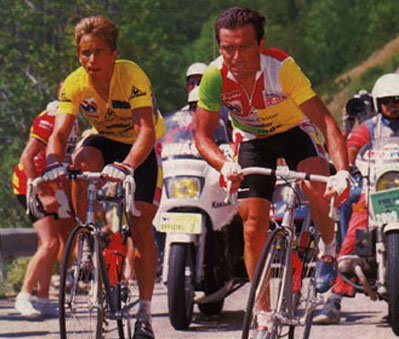
The 1986 Tour de France became the epic stage for this internal drama. Both men, dressed in the same distinctive Mondrian blocks, found themselves locked in a brutal battle for the yellow jersey. Hinault, having “helped” LeMond win in 1985 (a promise many felt he didn’t fully intend to keep), attacked relentlessly, testing his younger teammate at every turn. The public was captivated by the spectacle: two champions, ostensibly on the same side, pushing each other to their absolute limits.
Ultimately, LeMond prevailed, becoming the first American to win the Tour de France, but not without immense emotional and physical cost. The image of Hinault and LeMond, side-by-side in their Mondrian jerseys, battling not just competitors but each other, remains one of the most enduring and complex narratives in cycling history. The jersey, meant to unify, inadvertently became a silent witness to a very public and deeply personal struggle for supremacy.
3. Technological Firsts: Beyond the Aesthetics – Innovations on Two Wheels ⚙️
While the La Vie Claire jersey stole headlines for its looks and the team’s internal dramas, the squad was also a quiet pioneer of technological advancements that would shape modern cycling. Bernard Tapie’s forward-thinking approach wasn’t limited to aesthetics; he was keen to leverage every possible advantage.
La Vie Claire was one of the first professional teams to widely adopt:
- Carbon Fiber Frames: While nascent, the team experimented with early carbon fiber frames, recognizing their potential for weight reduction and stiffness long before they became ubiquitous. This pushed the boundaries of bike manufacturing, moving away from traditional steel.
- Clipless Pedals: The team was an early adopter of the revolutionary LOOK clipless pedal system. This invention, which allowed riders to “clip in” for more efficient power transfer and then quickly release, transformed bike control and pedaling efficiency. Hinault himself played a role in popularizing them after suffering a career-threatening knee injury, as clipless pedals offered more ergonomic foot positioning.
- Aero Dynamics: While less refined than today, the team’s overall approach to equipment, from helmets to wheelsets, focused on marginal gains in aerodynamics and performance.
The La Vie Claire jersey, therefore, represents a perfect confluence of art, human drama, and technological progress. It wasn’t just about winning races; it was about reinventing what a cycling team could be, both on and off the bike. The Mondrian blocks weren’t just colors; they were a badge of a revolutionary spirit.
Conclusion: The Enduring Legacy of La Vie Claire
Decades later, the La Vie Claire jersey remains one of the most sought-after and recognizable kits in cycling history. It evokes memories of fierce competition, groundbreaking design, and the dawn of modern cycling technology. For collectors and fans at PullingTurns.com, it’s more than just fabric; it’s a vibrant tapestry woven with the threads of innovation, rivalry, and timeless style.





Leave a Reply